TLDR
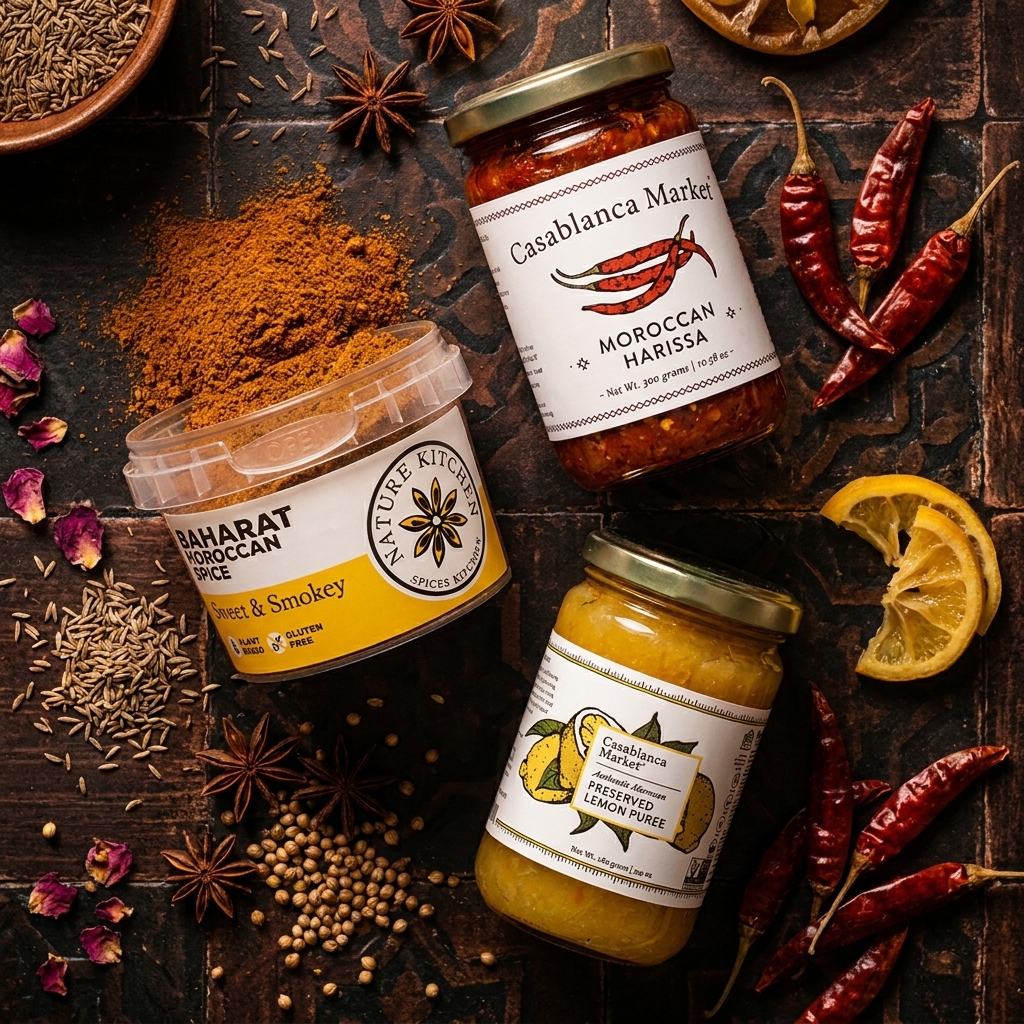
- Harissa, preserved lemon and baharat are the holy trinity of Moroccan cooking
- Together they cover heat, brightness and depth — three flavour dimensions that work in almost any dish
- This guide covers what each ingredient is, how to use it, and five easy recipes that showcase all three
- All recipes work for weeknight cooking and take 45 minutes or less
The Three Ingredients Every Moroccan Kitchen Needs
I've spent 28 years cooking professionally across three continents. Some ingredients come and go. These three never do.
Harissa, preserved lemon and baharat appear on professional kitchen shelves across Morocco, Tunisia, Algeria and the Middle East — and once you cook with them together, you'll understand why. They don't just add flavour. They transform a dish from flat to layered, from forgettable to the kind of thing people ask you about the next day.
If you've picked up a jar of harissa and weren't sure what to do with it — or if you've stared at a tub of baharat wondering whether it's worth the effort — this guide is for you. Five recipes, all straightforward, all built around these three ingredients.
What Makes These Three Ingredients Special?
What Is Harissa?
Harissa is a North African chilli paste originating from Tunisia, made from roasted red peppers, chillies, garlic, olive oil and spices including cumin, coriander and caraway. The word harissa comes from the Arabic harasa, meaning "to pound" — which tells you everything about how it's made. Source: Milk Street
The flavour is fiery but complex. It's warm and spicy without being incendiary, with smoky, slightly sweet undertones that make it far more interesting than straight chilli heat. Source: Serious Eats
What do you use harissa for? Almost anything. It works as a marinade for chicken, fish and lamb, stirred into stews and tagines, swirled through yogurt as a dip, or spread on flatbread. A tablespoon into roasted vegetables changes everything. Think of it as a flavour accelerator — it makes everything it touches taste more like itself, but better.
Moroccan harissa tends to be slightly milder and more aromatic than Tunisian versions, with rose petals and preserved lemon often worked into the blend.
What Is Preserved Lemon?
Preserved lemon is exactly what it sounds like: whole lemons cured in salt and their own juice over several weeks. The result is a flavour that shares almost nothing with fresh lemon beyond the name. The sharpness mellows into something softer, brinier and more complex — more fermented funk than citrus zing. Source: Mom's Kitchen Handbook
In Moroccan cooking, preserved lemon is indispensable. It goes into tagines, salads, couscous, marinades and sauces. You use the rind, not the flesh — scrape out and discard the pith, then chop the rind finely and add it wherever you want brightness without sharpness. Source: The Spruce Eats
Preserved lemon purée makes the whole process even easier — no prep, just spoon it straight in.
The key thing to understand: preserved lemon doesn't make food taste lemony. It makes food taste deeper, brighter and more alive. Once you've cooked with it, you'll reach for it constantly.
What Is Baharat Spice?
Baharat simply means "spices" in Arabic — which gives you an idea of how fundamental this blend is to the region's cooking. It's a warm, earthy, aromatic mix typically built around black pepper, cinnamon, cumin, coriander, cardamom, cloves and nutmeg, with the exact balance varying by country and kitchen. Source: Epicurious
The flavour is peppery, sweet-spiced and deeply savoury. Think the warming depth of cinnamon meeting the earthiness of cumin, with a hint of floral spice underneath. It works brilliantly on lamb, chicken and beef, but also on roasted vegetables, rice and pulses. A teaspoon into a pan of onions as they soften is one of the most transformative things you can do in a kitchen. Source: RecipeTin Eats
5 Easy Moroccan Harissa Recipes
These five recipes use at least one — and usually two or three — of the ingredients above. All of them work for home cooking without specialist equipment. None take more than 45 minutes.
1. Harissa Chicken Thighs with Preserved Lemon
Time: 35 minutes | Serves: 4 | Ingredients used: Harissa, Preserved Lemon
This is one of the most useful harissa recipes you'll learn. Chicken thighs are forgiving, flavourful and cheap — and harissa turns them into something restaurant-worthy with almost no effort.
How to make it:
Score 8 bone-in, skin-on chicken thighs and rub them generously with 3 tablespoons of Moroccan harissa, 1 teaspoon of preserved lemon purée, a glug of olive oil and a pinch of salt. If you have time, leave them in the fridge for an hour or overnight — though 10 minutes at room temperature works too.
Heat a heavy oven-safe pan over high heat. Sear the thighs skin-side down for 4–5 minutes until the skin is deep golden and beginning to crisp. Flip, then transfer to a 200°C oven for 20 minutes until cooked through.
Finish with a squeeze of fresh lemon and scatter with chopped flat-leaf parsley. Serve with flatbread or couscous to catch the pan juices.
Chef's tip: The preserved lemon in the marinade caramelises during cooking, adding a sweet-salty edge to the skin. Don't skip it.
2. Moroccan Chickpea Tagine with Harissa and Preserved Lemon
Time: 40 minutes | Serves: 4 | Ingredients used: Harissa, Preserved Lemon, Baharat | Suitable for: Vegetarians, Vegans
This is the recipe that wins over anyone who thinks vegetarian food can't be as satisfying as meat. It uses all three ingredients at once — and it tastes like it's been cooking for hours.
How to make it:
Soften 2 diced onions in olive oil over a medium heat for 8 minutes. Add 1 teaspoon of baharat and cook for another 2 minutes until fragrant. Stir in 2 tablespoons of harissa, 1 tin of chopped tomatoes, 400ml of vegetable stock and 2 tins of drained chickpeas.
Simmer for 20 minutes, then stir in 1 teaspoon of preserved lemon purée and check the seasoning. The lemon purée goes in at the end — it brightens everything without cooking away.
Serve over couscous or with crusty bread. Finish with a drizzle of olive oil and a handful of fresh coriander.
Chef's tip: Baharat and harissa together create a flavour that's hard to place — warming, complex and slightly smoky. People always ask what the secret ingredient is. Now you know.
3. One-Pot Baharat Chicken and Rice with Preserved Lemon
Time: 45 minutes | Serves: 4 | Ingredients used: Baharat, Preserved Lemon
This is the kind of dish that becomes a weekly staple. One pot, minimal washing up, and a result that tastes genuinely impressive.
How to make it:
Season 4 chicken thighs generously with baharat and salt. Brown them in a wide, deep pan with a little oil over high heat — 3 minutes per side. Remove and set aside.
In the same pan, soften 1 large diced onion for 5 minutes. Add 1½ cups of basmati rice and stir to coat in the pan juices. Pour in 2½ cups of chicken stock, add 1 teaspoon of preserved lemon purée, and nestle the chicken thighs back in on top.
Bring to the boil, then reduce to the lowest heat, cover tightly and cook for 22 minutes. Rest for 5 minutes before lifting the lid.
Serve directly from the pan with a green salad.
Chef's tip: The preserved lemon purée dissolves into the stock and perfumes every grain of rice. It's subtle but unmistakable — that background brightness that makes the dish feel complete.
4. Harissa Roasted Cauliflower Steaks with Baharat
Time: 30 minutes | Serves: 2–4 | Ingredients used: Harissa, Baharat | Suitable for: Vegetarians, Vegans
Cauliflower is one of the most underestimated vegetables in a British kitchen. Roasted hot with harissa and baharat, it becomes something entirely different — caramelised, smoky and deeply savoury.
How to make it:
Slice a large cauliflower into 2cm-thick steaks through the core. Mix 2 tablespoons of harissa with 1 tablespoon of olive oil, 1 teaspoon of baharat and a pinch of salt. Brush the mixture generously over both sides of each steak.
Lay on a lined baking tray and roast at 220°C for 22–25 minutes, flipping once, until the edges are charred and the flesh is tender throughout.
Serve with tahini drizzled over the top, a handful of pomegranate seeds and flat-leaf parsley. Or serve as a side alongside the baharat chicken and rice above.
Chef's tip: The high temperature is essential. You want real caramelisation on the outside, not steaming. Don't be tempted to lower the oven.
5. Baharat Lamb Koftas with Harissa Dipping Sauce
Time: 25 minutes | Serves: 4 | Ingredients used: Baharat, Harissa
Koftas are one of the simplest forms of cooking there is — spiced minced meat, shaped and cooked fast. Baharat is the classic seasoning choice, and harissa makes the obvious dip.
How to make it:
Mix 500g of minced lamb with 1½ teaspoons of baharat, 1 grated garlic clove, 1 teaspoon of salt and a small handful of chopped flat-leaf parsley. Shape into 8 elongated patties and press them onto metal or soaked wooden skewers.
Grill or griddle over high heat for 3–4 minutes per side until cooked through with good colour on the outside.
For the dipping sauce: mix 3 tablespoons of Greek yogurt with 1 tablespoon of harissa and a squeeze of lemon. Done.
Serve with flatbread, sliced red onion and a simple tomato salad.
Chef's tip: Don't overwork the mince when mixing. The more you handle it, the denser the koftas become. Mix until just combined.
Want Recipes Built Around These Exact Ingredients?
These five recipes give you a strong starting point. But if you want to go further — more harissa recipes, more ideas for preserved lemon, or Moroccan dishes built around whatever dietary requirements you're cooking for — that's exactly what FlavourFrontier does.
Set your mood, your dietary needs and your cook time. The app generates a recipe tailored to you — and if you have the Moroccan box ingredients to hand, it can build dishes specifically around what's in your kitchen.
From May 2026, the Moroccan Frontier Box brings all three of these ingredients — Casablanca Market Moroccan Harissa, Casablanca Market Preserved Lemon Purée and Nature Kitchen Baharat Moroccan Spice — directly to your door in a single first-edition drop of 100 units. Every box comes with 6 months of free access to the AI Meal Planner, with recipes generated around exactly what's inside.
Join the waitlist here — 100 units only.
Conclusion
Harissa, preserved lemon and baharat are three ingredients that change the way you cook. Not occasionally, not for special occasions — permanently. Once they're in your kitchen, you'll find a reason to reach for them almost every time you cook.
The five harissa recipes above — from quick weeknight chicken to a deeply satisfying vegetarian tagine — are a foundation, not a ceiling. These three ingredients work across dozens of dishes, cuisines and dietary requirements. The more you use them, the more natural they become.
Start with one recipe. See what happens. You probably won't stop there.
Mark Boutros is a professional chef with 28 years of experience, having worked in Dubai, Holland and America. He founded FlavourFrontier to bring real culinary knowledge into everyday home cooking.
 FlavourFrontier
Leave a comment